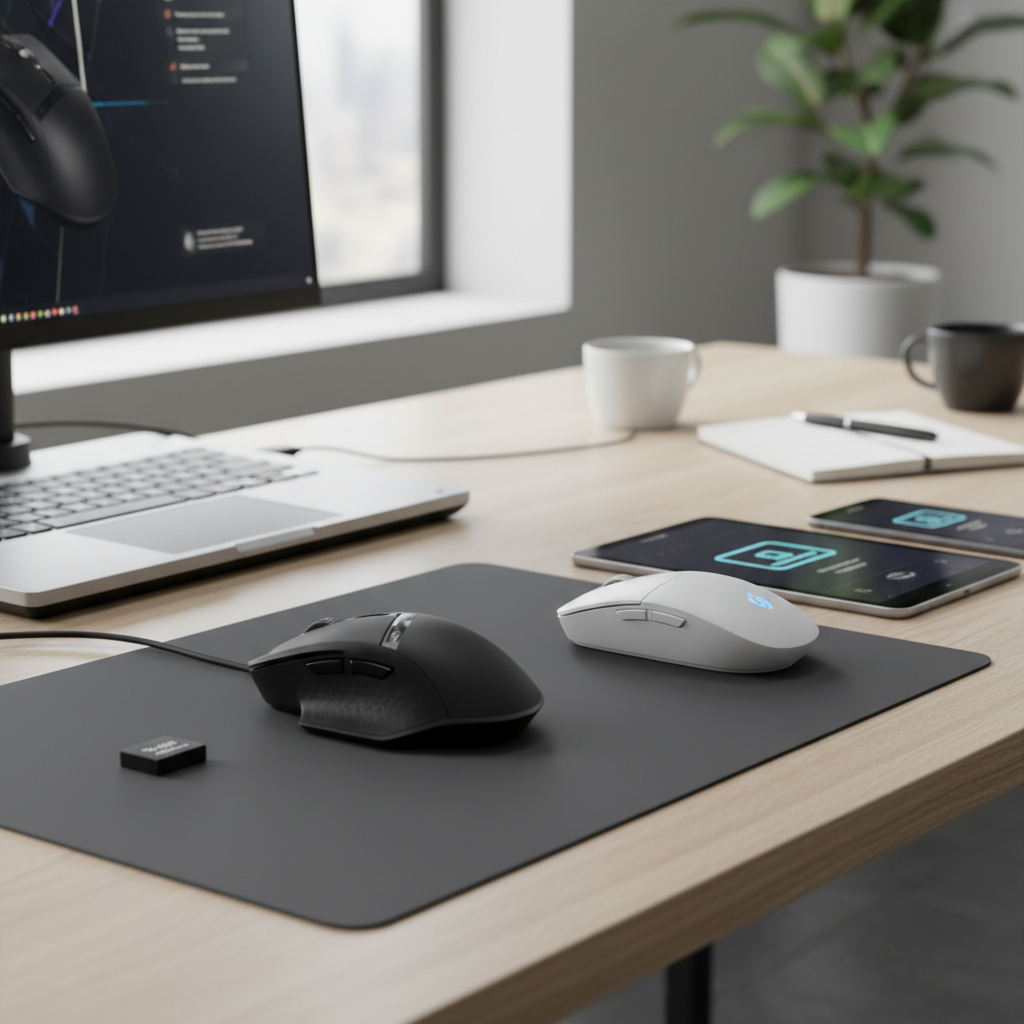
Choosing between a Bluetooth and 2.4GHz wireless mouse in 2026 depends on your primary use: 2.4GHz offers superior low-latency performance essential for gaming and critical work, while Bluetooth provides broader compatibility and better power efficiency for general productivity across multiple devices without needing a USB dongle.
Introduction: Decoding Wireless Mouse Technology in 2026
Wireless mice have become the standard, offering unparalleled freedom and desk aesthetics. Yet, the core choice between 2.4GHz and Bluetooth connectivity remains crucial for optimal performance. Understanding their differences is key to selecting the perfect peripheral for your 2026 digital lifestyle.
What is 2.4GHz Wireless Technology for Mice?
2.4GHz wireless technology utilizes a dedicated USB dongle that plugs into your computer, establishing a direct, high-speed radio frequency connection. This method operates on the same 2.4GHz band as Wi-Fi and other devices but employs proprietary protocols for robust, low-latency communication. Essentially, the dongle acts as a dedicated receiver, minimizing interference and maximizing signal integrity for the mouse.
How Does 2.4GHz Achieve Low Latency?
|
Our Picks for the Best Computer mouse in 2026
As an Amazon Associate I earn from qualifying purchases.
|
||
| Num | Product | Action |
|---|---|---|
| 1 | acer Wireless Mouse for Laptop, 2.4GHz Computer Mouse 3 Adjustable DPI Office Cordless USB Mice with USBA Receiver, 6 Buttons, 1600 DPI, Medium to Large Sized Hands Compatible with PC, Laptop, Desktop |

|
| 2 | TECKNET Ergonomic Mouse, Wireless Vertical Mouse, 4800 DPI, Rechargeable Bluetooth Mice for Carpal Tunnel Right Hand, 3-Device Connectivity for Laptop, PC, MacBook, Black |
|
| 3 | Amazon Basics 2.4 Ghz Wireless Optical Computer Mouse with USB Nano Receiver, Black |
|
| 4 | Amazon Basics 3-Button USB Wired Mouse with Responsive Tracking, Plug & Play, Compatible with Windows and Mac, Black |
|
| 5 | Logitech B100 Wired Mouse for Computer and Laptop, USB Corded Mouse, Right or Left Hand Use - Black |
|
| 6 | Logitech M185 Wireless Mouse, 2.4GHz with USB Mini Receiver, 12-Month Battery Life, 1000 DPI Optical Tracking, Ambidextrous PC/Mac/Laptop - Swift Grey |
|
| 7 | Redragon M997 Magnesium Alloy Wireless Gaming Mouse, Tri-Mode BT & 2.4GHz, Ultra Lightweight Ergonomic Mouse, 1000Hz, Rechargeable for PC Laptop, Starlight Black |
|
| 8 | Wireless Bluetooth Mouse, Rechargeable, LED, Silent, Ultra-thin Design (Bluetooth 5.2 and 2.4GHz USB Receiver) | Portable Computer Mouse for Laptops, iPads, MacBooks and Apple Devices (Black) |
|
| 9 | Logitech MX Master 4, Ergonomic Wireless Mouse with Advanced Performance Haptic Feedback, Ultra-Fast Scrolling, USB-C Charging, Bluetooth, Windows, MacOS - Graphite |
|
| 10 | Logitech M510 Wireless Mouse, 2.4 GHz with USB Unifying Receiver, 1000 DPI Laser-Grade Tracking, 7-Buttons, 24-Months Battery Life, PC/Mac/Laptop - Graphite |
|
The primary advantage of 2.4GHz is its extremely low latency and high polling rate. Modern 2.4GHz mice, like the Logitech G Pro X Superlight 2 or Razer DeathAdder V3 Pro, can achieve polling rates of up to 2000Hz (0.5ms response time), with some cutting-edge models even reaching 8000Hz (0.125ms). This near-instantaneous feedback is critical for competitive gaming, graphic design, and other precision-demanding tasks. The dedicated dongle ensures a direct, unshared communication channel, bypassing the need for operating system-level Bluetooth stack management, which can introduce delays.
Advantages and Disadvantages of 2.4GHz Mice
- Pros:
- Ultra-Low Latency: Ideal for gaming and professional applications where every millisecond counts.
- High Polling Rates: Offers smoother cursor movement and more precise tracking.
- Reliable Connection: Less susceptible to general interference compared to Bluetooth in crowded environments due to dedicated pairing.
- Plug-and-Play: Often requires no complex pairing process; just plug in the dongle.
- Cons:
- Requires USB Dongle: Occupies a USB port, which can be scarce on modern ultrabooks.
- Limited Device Switching: Typically paired to one dongle, making quick switching between multiple devices cumbersome.
- Potential for Dongle Loss: The small dongle is easily misplaced.
What is Bluetooth Wireless Technology for Mice?
Bluetooth technology, specifically Bluetooth Low Energy (LE) 5.0 and newer versions (like 5.2 and 5.3 prevalent in 2026), allows devices to connect directly to a computer’s built-in Bluetooth receiver without a separate dongle. It’s an open wireless standard designed for short-range communication, primarily focused on versatility and power efficiency. Bluetooth mice leverage this standard for broad compatibility across laptops, tablets, and even smart TVs.
How Does Bluetooth Prioritize Versatility and Efficiency?
Bluetooth’s strength lies in its ability to connect to multiple devices and its optimized power consumption. A single Bluetooth mouse, such as the Logitech MX Master 3S or Microsoft Arc Mouse, can often pair with up to three devices simultaneously, switching between them with a button press. Bluetooth LE, in particular, dramatically extends battery life, allowing mice to operate for months or even years on a single charge or set of batteries. While its latency is typically higher than 2.4GHz (often 8-12ms, though newer implementations are improving), it’s perfectly acceptable for general productivity tasks, web browsing, and office work.
Advantages and Disadvantages of Bluetooth Mice
- Pros:
- No USB Dongle Required: Frees up USB ports, ideal for devices with limited connectivity.
- Multi-Device Connectivity: Easily switch between several paired computers, tablets, or phones.
- Excellent Power Efficiency: Bluetooth LE significantly extends battery life.
- Broad Compatibility: Works with almost any modern device equipped with Bluetooth.
- Cons:
- Higher Latency: Generally not suitable for competitive gaming or highly precise design work.
- Potential for Interference: Can be more susceptible to signal degradation in environments with many Bluetooth or Wi-Fi devices.
- Initial Pairing Process: Requires a pairing process for each new device.
- Operating System Dependency: Relies on the host device’s Bluetooth stack, which can sometimes be less stable than a dedicated dongle.
How Do 2.4GHz and Bluetooth Mice Compare in 2026?
To make an informed decision, it’s essential to directly compare the key attributes of 2.4GHz and Bluetooth wireless mice as they stand in 2026. While both have evolved, their fundamental strengths and weaknesses persist.
| Feature | 2.4GHz Wireless Mice (2026) | Bluetooth Wireless Mice (2026) |
|---|---|---|
| Latency (Response Time) | Ultra-low (0.125ms – 2ms typically, some 8000Hz models lower) | Low to Moderate (8ms – 20ms typically, improving with BT 5.x) |
| Polling Rate | Very High (1000Hz – 8000Hz common for gaming) | Moderate (125Hz – 250Hz common, some newer models higher) |
| Connectivity | Dedicated USB Dongle (USB-A or USB-C) | Built-in Bluetooth receiver (no dongle needed) |
| Multi-Device Support | Limited (typically one device per dongle, some advanced models offer multi-dongle support or dual-mode) | Excellent (often 2-3 devices, easy switching) |
| Power Efficiency | Good (varies by model, often requires more power for higher performance) | Excellent (Bluetooth LE extends battery life significantly) |
| Interference Susceptibility | Low (dedicated connection, less prone to general wireless noise) | Moderate (can be affected by dense wireless environments) |
| Typical Use Case | Competitive gaming, graphic design, CAD, professional tasks requiring precision | General productivity, office work, travel, multi-device setups, HTPCs |
| Examples (2026 models) | Logitech G Pro X Superlight 2, Razer Viper V2 Pro, SteelSeries Aerox 9 | Logitech MX Master 3S, Microsoft Arc Mouse, Apple Magic Mouse |
Which Wireless Mouse is Best for Your Needs in 2026?
The “best” wireless mouse is subjective, dictated by your specific applications and priorities. Consider these scenarios to guide your choice:
- For Competitive Gaming: Prioritize 2.4GHz. The ultra-low latency and high polling rates (e.g., 2000Hz or 4000Hz) offered by mice like the Razer DeathAdder V3 Pro or Corsair Darkstar Wireless are non-negotiable for precision and responsiveness.
- For Professional Design/CAD Work: 2.4GHz is generally preferred. While some Bluetooth mice offer advanced features, the consistent, lag-free experience of 2.4GHz ensures meticulous control for tasks in Adobe Creative Suite or SolidWorks.
- For General Office & Productivity: Bluetooth is an excellent choice. A Logitech MX Master 3S offers ergonomic comfort, programmable buttons, and seamless multi-device switching, perfect for a dynamic workflow without consuming a USB port.
- For Travel & Mobile Productivity: Bluetooth is ideal. Its dongle-free operation and multi-device capabilities make it perfect for pairing with laptops, tablets, and even smartphones on the go.
- For Home Theater PCs (HTPCs) & Entertainment Centers: Bluetooth often makes more sense. You typically don’t need ultra-low latency, and the ability to connect without a dongle to a TV-connected mini-PC is convenient.
- For Devices with Limited USB Ports (e.g., Ultrabooks, Tablets): Bluetooth is the clear winner. Preserve your precious USB-C ports for charging or other peripherals.
- For Eco-Conscious Users Prioritizing Battery Life: Bluetooth LE mice generally offer superior battery longevity, reducing the frequency of charging or battery replacement.
Key Features to Look for in a 2026 Wireless Mouse
Beyond the connectivity type, several features define a premium wireless mouse experience in 2026:
Ergonomics and Comfort
A mouse should fit your hand naturally. Consider your grip style (palm, claw, fingertip) and hand size. Ergonomic designs, like those found in the MX Master series, reduce strain during long sessions. Look for textured grips, thumb rests, and balanced weight distribution.
DPI and Tracking Performance
DPI (Dots Per Inch) indicates sensor sensitivity. Modern sensors offer ranges from 100 to over 30,000 DPI. High DPI is beneficial for large monitors or multi-monitor setups. Look for optical sensors (like Logitech’s HERO or Razer’s Focus Pro 30K Optical Sensor) known for precision and consistent tracking on various surfaces, often supporting tracking on glass.
Battery Life and Charging
Expect long battery life, often 70+ hours for gaming mice and several months for productivity mice. USB-C charging is standard for fast, convenient power replenishment. Some models offer wireless charging compatibility (Qi standard) for ultimate convenience.
Programmable Buttons and Software
Many mice feature customizable buttons (e.g., 5-15 buttons). Companion software (e.g., Logitech G HUB, Razer Synapse) allows remapping buttons, creating macros, and adjusting DPI settings. This is crucial for power users and gamers.
Build Quality and Durability
Look for robust construction, high-quality plastics, and durable switches. Optical switches (e.g., Razer Optical Mouse Switches Gen-3) are gaining popularity for their faster actuation and longer lifespan (up to 90 million clicks) compared to traditional mechanical switches.
Quiet Click Technology
For office environments or shared spaces, “silent click” mice (e.g., Logitech M220 Silent, MX Master 3S with Quiet Click technology) reduce click noise by up to 90% compared to standard mice, making them significantly less disruptive.
Frequently Asked Questions
What is the difference between 2.4GHz and Bluetooth latency?
2.4GHz wireless mice typically offer much lower latency, often between 0.125ms and 2ms, due to their dedicated dongle and proprietary protocols. Bluetooth mice, even with modern Bluetooth LE 5.x, usually have latencies ranging from 8ms to 20ms, which is fine for general use but noticeable in competitive gaming or precision tasks.
Can a wireless mouse support both 2.4GHz and Bluetooth?
Yes, many premium wireless mice in 2026 are “dual-mode” or “tri-mode.” These mice, like the Logitech MX Master 3S or Razer Basilisk V3 Pro, can connect via their 2.4GHz USB dongle for low latency or via Bluetooth for dongle-free, multi-device convenience. This offers the best of both worlds.
Do 2.4GHz dongles use a standard USB port?
Yes, most 2.4GHz dongles use a standard USB-A port. However, with the increasing prevalence of USB-C on modern laptops and devices, some manufacturers are now offering USB-C dongles or including a USB-A to USB-C adapter in the box.
Is a higher polling rate always better for a mouse?
For gaming and professional precision tasks, a higher polling rate (e.g., 1000Hz, 2000Hz, 4000Hz, or even 8000Hz) provides smoother cursor movement and more accurate input, which can be a significant advantage. For general productivity, a standard 125Hz or 250Hz polling rate is perfectly adequate and uses less power.
Will 2.4GHz wireless interfere with my Wi-Fi?
Both 2.4GHz wireless mice and Wi-Fi networks operate on the same 2.4GHz frequency band. While modern devices are designed to coexist and minimize interference, in extremely crowded wireless environments, some minor interference can occur. However, dedicated 2.4GHz mouse protocols are robust and generally maintain a stable connection.
Conclusion
The choice between a 2.4GHz and Bluetooth wireless mouse in 2026 is clearer than ever: prioritize 2.4GHz for performance-critical applications like gaming and design, and opt for Bluetooth for versatility, multi-device connectivity, and extended battery life in general productivity scenarios. Many premium mice now offer both, providing a flexible solution for users who demand the best of both worlds. Evaluate your primary needs, consider the key features, and select the technology that best empowers your digital interactions.