In today’s digital age, the computer mouse remains an indispensable tool, but the sheer variety can make choosing the right one a daunting task. The fundamental decision often boils down to a wired versus wireless connection. This comprehensive guide, crafted from over a decade of experience, will demystify the options and provide the insights you need to select the perfect computer mouse for your workflow, gaming, or everyday use.
An Overview of the Computer Mouse
A computer mouse is a handheld pointing device that detects two-dimensional motion relative to a surface. Its evolution from the humble trackball to today’s high-precision sensors has revolutionized how we interact with computers. Currently, popular types include wired, wireless, gaming-specific, and ergonomic models, each offering distinct advantages and disadvantages.
Wired mice offer a stable, reliable connection and typically boast lower latency, making them a favorite among competitive gamers and those who prioritize responsiveness. They eliminate concerns about battery life and are generally more affordable. However, the attached cable can restrict movement and contribute to desk clutter, potentially limiting their convenience for laptop users or on-the-go professionals.
Conversely, wireless mice provide superior freedom of movement and contribute to a cleaner, more aesthetic workspace. They are ideal for laptops and for users who prefer to operate their computer from a distance. The primary drawbacks include the need for batteries or regular charging, which can be inconvenient, and a slight risk of connectivity issues or input lag, though modern wireless technology has significantly minimized these concerns.
Your Guide to Choosing the Right Computer Mouse
Selecting a computer mouse isn’t a one-size-fits-all decision; it requires careful consideration of your specific needs and priorities.
Determine Your Usage Needs
|
Our Picks for the Best Computer mouse in 2026
As an Amazon Associate I earn from qualifying purchases.
|
||
| Num | Product | Action |
|---|---|---|
| 1 | Logitech B100 Wired Mouse for Computer and Laptop, USB Corded Mouse, Right or Left Hand Use - Black |

|
| 2 | acer Wireless Mouse for Laptop, 2.4GHz Computer Mouse 3 Adjustable DPI Office Cordless USB Mice with USBA Receiver, 6 Buttons, 1600 DPI, Medium to Large Sized Hands Compatible with PC, Laptop, Desktop |
|
| 3 | Amazon Basics 2.4 Ghz Wireless Optical Computer Mouse with USB Nano Receiver, Black |
|
| 4 | Redragon M997 Magnesium Alloy Wireless Gaming Mouse, Tri-Mode BT & 2.4GHz, Ultra Lightweight Ergonomic Mouse, 1000Hz, Rechargeable for PC Laptop, Starlight Black |
|
| 5 | Logitech MX Master 4, Ergonomic Wireless Mouse with Advanced Performance Haptic Feedback, Ultra-Fast Scrolling, USB-C Charging, Bluetooth, Windows, MacOS - Graphite |
|
| 6 | Wireless Bluetooth Mouse, Rechargeable, LED, Silent, Ultra-thin Design (Bluetooth 5.2 and 2.4GHz USB Receiver) | Portable Computer Mouse for Laptops, iPads, MacBooks and Apple Devices (Black) |
|
| 7 | Logitech M510 Wireless Mouse, 2.4 GHz with USB Unifying Receiver, 1000 DPI Laser-Grade Tracking, 7-Buttons, 24-Months Battery Life, PC/Mac/Laptop - Graphite |
|
| 8 | Amazon Basics 3-Button USB Wired Mouse with Responsive Tracking, Plug & Play, Compatible with Windows and Mac, Black |
|
| 9 | Logitech M185 Wireless Mouse, 2.4GHz with USB Mini Receiver, 12-Month Battery Life, 1000 DPI Optical Tracking, Ambidextrous PC/Mac/Laptop - Swift Grey |
|
| 10 | TECKNET Ergonomic Mouse, Wireless Vertical Mouse, 4800 DPI, Rechargeable Bluetooth Mice for Carpal Tunnel Right Hand, 3-Device Connectivity for Laptop, PC, MacBook, Black |
|
Before diving into specifications, reflect on how you primarily use your mouse. Are you a professional spending long hours on office tasks, a graphic designer demanding pixel-perfect precision, or a dedicated gamer where every millisecond counts? Your daily usage frequency and your budget also play crucial roles in narrowing down the best options. For instance, office workers might prioritize an ergonomic design and quiet clicks, while gamers seek high DPI and programmable buttons.
Key Factors When Selecting a Mouse
Several technical specifications and design elements contribute to a mouse’s overall performance and comfort.
DPI (Dots Per Inch): DPI, or Dots Per Inch (often interchangeable with CPI, Counts Per Inch), measures your mouse’s sensitivity, dictating how far the cursor moves on screen in response to physical movement. A higher DPI means faster cursor movement with less physical mouse movement, while a lower DPI provides finer control and precision. For general office tasks, a DPI range of 800-1200 is often ideal. Graphic designers and video editors typically benefit from lower DPI settings (400-1000) for enhanced accuracy, while gamers might prefer a range between 800-1600 for a balance of speed and precision. The optimal DPI also depends on your monitor’s resolution; higher resolution screens may require higher DPI to maintain a comfortable cursor speed.
Ergonomics and Size: An ergonomic design is crucial for preventing wrist strain and discomfort, especially during extended use. These mice are sculpted to conform to the natural shape of the hand, promoting a more comfortable “handshake” position. Consider your grip style (palm, claw, or fingertip) and hand size. Larger mice often suit palm grips, while smaller, more contoured designs might benefit claw and fingertip grips. Features like thumb rests, adjustable weights, and comfortable grip types are essential for long-term comfort.
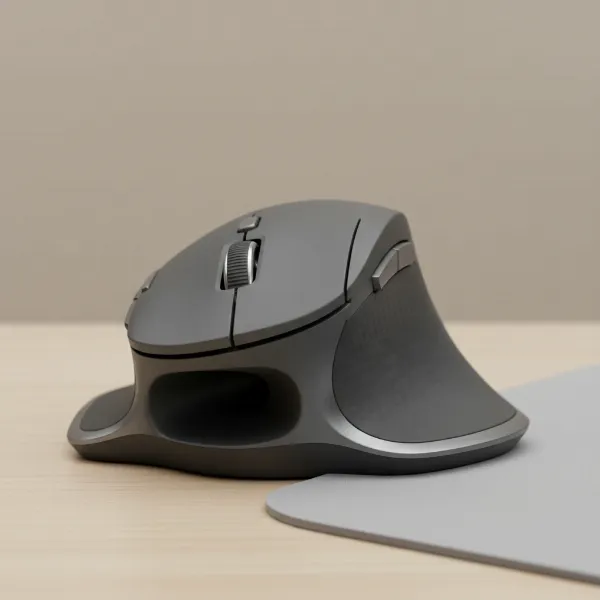 Ergonomic computer mouse designed for comfortable use, reducing wrist strain.
Buttons: Basic mice feature two buttons and a scroll wheel, sufficient for most everyday tasks. However, many modern mice offer additional programmable buttons, which can be incredibly useful for macros in gaming or shortcuts in productivity software. Consider how many extra buttons you would genuinely use on a daily basis.
Connectivity (Wired/Wireless): The choice between wired and wireless connectivity significantly impacts convenience and performance. Wired mice offer guaranteed reliability and responsiveness with no battery concerns, making them a preferred choice for competitive gaming or mission-critical tasks where even a minuscule delay is unacceptable. Wireless mice, connecting via a USB receiver or Bluetooth, excel in portability and desk aesthetics, allowing for a clutter-free setup and greater range of motion. High-end wireless gaming mice have advanced to minimize latency, often performing comparably to wired models for most users.
Sensor Technology: The two primary types of tracking technology are optical and laser. Optical mice use an LED to illuminate the surface, while laser mice use a laser diode.
- Optical mice generally provide stable and consistent tracking on matte, non-reflective surfaces, making them a reliable choice for everyday computing and gaming. They often have lower latency and are typically more affordable.
- Laser mice can track on a wider range of surfaces, including glass and glossy materials, due to their ability to penetrate deeper into the surface. They often offer higher DPI settings but can sometimes introduce unwanted jitter or perceived acceleration due to capturing excessive surface detail. For most gaming scenarios, an optical mouse is often considered the safer choice for consistent tracking.
Battery Life (Wireless): For wireless mice, battery life is a key consideration. Modern wireless mice can last weeks or even months on a single charge or set of batteries, with some supporting wireless charging. However, managing battery levels is still necessary, and a mouse dying mid-task can be frustrating.
Comparing Popular Mouse Models
Here’s a comparative look at some popular computer mouse models across different categories:
| Model | DPI Range | Design | Buttons | Connectivity | Sensor | Price (Approx.) | Pros | Cons |
|---|---|---|---|---|---|---|---|---|
| Logitech MX Master 4 | Up to 8000 | Ergonomic (Right-hand) | 7 | Wireless (BT/USB) | Laser | $99-$110 | Highly customizable, multi-device, silent clicks, tracks on glass, excellent battery life | Premium price, less ideal for competitive FPS gaming |
| Razer DeathAdder V4 Pro | Up to 30000+ | Ergonomic (Right-hand) | 6 | Wireless (2.4GHz) | Optical | $150-$160 | Ultra-light, high precision, exceptional battery life, very low latency, ideal for gaming | High price, primarily gaming-focused |
| Logitech MX Vertical | 400-4000 | Vertical Ergonomic | 6 | Wireless (BT/USB) | Optical | $80-$100 | Reduces wrist and forearm strain, natural handshake position, precise tracking | Takes getting used to, heavier than standard mice, not ideal for fast-paced gaming |
| Razer Basilisk V3 | Up to 26000 | Ergonomic (Right-hand) | 11 | Wired | Optical | $70-$80 | Feature-rich, customizable buttons, excellent for gaming & productivity, comfortable thumb rest | Wired cable, heavier than some gaming mice |
| Ugreen M571 Vertical Mouse | Up to 4000 | Vertical Ergonomic | 6 | Wireless (BT/USB) | Optical | $30-$40 | Affordable ergonomic option, reduces wrist pain for office work | May not be as precise or feature-rich as premium ergonomic mice |
| Logitech G Hero Wired | Up to 25600 | Gaming Ergonomic | 11 | Wired | Optical | $40-$60 | Adjustable weight, onboard memory, RGB lighting, excellent sensor, budget-friendly gaming | Wired cable can be cumbersome, design might be aggressive for office use |
“The perfect mouse isn’t just about high specs; it’s about the synergy between the device and your hand, tailored to how you spend your digital day.” – Admin, ReviewMew.com
Top-Rated Computer Mice for Every Need
With a plethora of options available, certain models consistently stand out for their performance and features across various use cases.
For gamers, the Razer DeathAdder V4 Pro is often recommended for its ultra-light design, high precision, and low latency, making it a top contender in competitive scenarios. Another strong choice is the Razer Basilisk V3, which blends gaming performance with ergonomic support, featuring a comfortable thumb rest and programmable buttons suitable for both gaming and general productivity. For those seeking an affordable wired gaming mouse, the Logitech G Hero Wired Gaming Mouse offers excellent value with its high DPI sensor and customizable features.
In the realm of office and productivity, the Logitech MX Master 4 (and its predecessor, the 3S) is a perennial favorite, lauded for its ergonomic design, multi-device connectivity, silent clicks, and ability to track on virtually any surface, including glass. For users experiencing wrist strain, vertical mice like the Logitech MX Vertical or the more budget-friendly Ugreen M571 Vertical Mouse are highly effective in promoting a natural “handshake” posture to reduce forearm pronation and discomfort.
Tips for Computer Mouse Usage and Maintenance
Proper care and usage habits can significantly extend the lifespan and performance of your computer mouse.
Regularly clean your mouse to prevent dust and debris from accumulating around the sensor and buttons, which can affect tracking accuracy and click responsiveness. For optical and laser sensors, a gentle wipe with a microfiber cloth is usually sufficient.
Adjusting DPI settings is crucial for optimizing your experience. Most modern mice, especially gaming and productivity models, allow for on-the-fly DPI adjustments via dedicated buttons or software. Experiment to find the ideal DPI for different tasks—a higher setting for broad movements across large monitors and a lower setting for precision tasks like graphic design. Disabling “mouse acceleration” (often called “Enhance Pointer Precision” in Windows) can also provide more consistent, 1-to-1 cursor movement, which is critical for muscle memory in gaming.
To extend the battery life of wireless mice, several practices can be beneficial:
- Turn it off: If you won’t be using your wireless mouse for an extended period (e.g., more than 30 minutes or overnight), remember to switch it off using the power button, if available.
- Keep receiver close: Maintain a close proximity between your mouse and its USB receiver (for 2.4GHz models) to minimize signal interference and reduce power consumption.
- Use a light-colored mouse pad: Dark, rough, or dull surfaces can make the mouse sensor work harder, consuming more power. A light-colored, reflective mouse pad can help conserve battery life.
- Quality batteries: When replacing batteries, opt for high-quality alkaline batteries and replace both at the same time, avoiding mixing brands.
- Adjust polling rate and DPI: Lowering the polling rate (how often the mouse reports its position) and DPI can reduce power consumption, finding a balance between performance and energy efficiency.
Detailed Comparison: Types of Computer Mice
Understanding the core differences between various mouse types is essential for making an informed decision.
Wired vs. Wireless Mice: The choice fundamentally impacts desk organization and mobility. Wired mice provide an uninterrupted power supply and a direct, lag-free connection, ensuring peak performance without battery concerns. This makes them a strong choice for competitive gaming or professional work requiring utmost precision. However, the cable can limit movement, create clutter, and may not be ideal for travel. Wireless mice offer unparalleled freedom, portability, and a clean aesthetic, perfect for modern minimalist setups or users who frequently move their laptop. While older models might have suffered from lag or connectivity issues, advanced wireless technologies have largely mitigated these concerns, with high-end wireless mice now performing on par with their wired counterparts for most users. The trade-off remains battery management, though many devices offer impressive battery longevity.
Optical vs. Laser Sensors: Both optical and laser sensors utilize light to track movement, but their mechanisms differ. Optical mice use an LED, which works best on textured, opaque, and matte surfaces like cloth mouse pads, offering stable and consistent tracking with less jitter. They are generally more affordable and often preferred by competitive gamers for their reliable 1:1 tracking. Laser mice use an invisible laser beam, allowing them to track on a wider variety of surfaces, including glossy or glass desktops, by penetrating deeper into the surface texture. While offering higher maximum DPI, laser sensors can sometimes pick up too much surface detail, leading to micro-jitters or acceleration, which might affect precision for critical tasks or high-level gaming.
Ergonomic vs. Standard Mice: Standard mice come in various shapes and sizes, often prioritizing compact design or basic functionality. Ergonomic mice, on the other hand, are specifically designed to reduce physical strain and discomfort over long periods of use. They often feature sculpted shapes that encourage a more natural hand and wrist posture, such as a vertical orientation or a thumb rest. While they may take some getting used to, the health benefits in preventing repetitive strain injuries (RSI) make them a worthwhile investment for heavy computer users.
Where to Purchase Your Computer Mouse
Finding the right computer mouse is easier than ever, with numerous reputable retailers offering a wide selection.
Online Retailers: Large online marketplaces such as Amazon, Best Buy, Newegg, Staples, and Target offer extensive collections of computer mice from all major brands, often with competitive pricing and detailed customer reviews. Many brand-specific stores, like Dell and HP, also sell their peripherals directly.
Physical Stores: For those who prefer to try a mouse before buying, electronics retailers like Best Buy, Staples, and Target allow you to physically hold and test different models for comfort and grip. This hands-on approach can be particularly valuable when choosing an ergonomic mouse.
When buying a computer mouse online, always verify the retailer’s warranty policy and return options. Reading user reviews can also provide valuable insights into real-world performance and durability, helping you make a more informed decision.
Buying Guide – Essential Considerations
Making the final decision involves synthesizing all the factors discussed.
Budget: Computer mice range from basic, budget-friendly options to high-end, feature-rich models. Determine how much you’re willing to invest, keeping in mind that a higher price often correlates with advanced features, better sensors, and superior build quality. You can find reliable mice for general use at lower price points, while specialized gaming or ergonomic mice might require a larger investment.
Brand Reputation: Established brands like Logitech, Razer, SteelSeries, Corsair, and Microsoft have a long history of producing quality peripherals. Researching brand reputation and reading reviews from trusted sources can provide assurance regarding product quality, customer support, and driver software reliability.
Read Reviews: Before making a final purchase, take the time to read reviews from both professional critics and everyday users. These reviews often highlight practical aspects, such as actual battery life, software usability, and long-term comfort, which might not be immediately apparent from product specifications alone.
Conclusion
Choosing the ideal computer mouse, whether wired or wireless, ultimately depends on your individual needs, preferences, and how you interact with your digital world. By carefully considering factors like DPI, ergonomics, connectivity, and sensor technology, you can find a device that enhances both your productivity and comfort. Don’t underestimate the impact a well-chosen computer mouse can have on your daily computing experience. What specific feature do you value most in your perfect mouse?
Frequently Asked Questions
Is a wireless mouse good for gaming?
Modern wireless gaming mice have significantly advanced, offering low latency and stable connections that can rival wired counterparts for most gamers. While professional esports players might still prefer wired mice for minimal latency, casual and even many serious gamers will find high-end wireless mice perfectly suitable, offering freedom of movement without noticeable lag.
What DPI is best for general use?
For general office tasks like web browsing, email, and word processing, a DPI range of 800-1200 is generally considered ideal. This range provides a good balance of cursor speed and precision, allowing for comfortable navigation across most screen resolutions without requiring excessive physical movement.
How often should I clean my computer mouse?
It’s a good practice to clean your computer mouse regularly, ideally once a week or whenever you notice dust or grime accumulating. Keeping the sensor clean ensures accurate tracking, while wiping down the body and buttons prevents sticky residue buildup and maintains hygiene.
Can I use a laser mouse on any surface?
Laser mice are known for their versatility and can track on a wider range of surfaces compared to optical mice, including glass and glossy desks. However, while they may function on most surfaces, highly reflective or transparent materials might still cause inconsistencies or “jitter” in tracking due to the way the laser interacts with the surface.
Do ergonomic mice really help with wrist pain?
Yes, ergonomic mice are specifically designed to promote a more natural hand and wrist posture, which can significantly help alleviate and prevent wrist pain, carpal tunnel syndrome, and other repetitive strain injuries. They encourage a relaxed grip and minimize forearm pronation, leading to greater comfort during extended computer use.